MPW Logo
  • Writers
  • Services
    • Descriptive Essay
    • Argumentative Essay
    • Nursing Essay
    • History Essay
    • Research Paper
    • Term Paper
    • Thesis
    • Dissertation
    • Admission Essay
    • View All Services
  • About Us
  • Pricing
  • Samples
  • Blog
Place an Order
  • Login
  • Signup
MPW Logo
MPW Logo
  • Writers Icon Writers
  • Services Icon Services
    • Descriptive Essay
    • Argumentative Essay
    • Nursing Essay
    • History Essay
    • Research Paper
    • Term Paper
    • Thesis
    • Dissertation
    • Admission Essay
    • View All Services
  • About Us Icon About Us
  • Pricing Icon Pricing
  • Samples Icon Samples
  • Blog Icon Blog
  • Account Icon Account
    • Login
    • Sign Up
Place an Order
Email Icon info@myperfectwords.com Phone Icon (+1) 888 687 4420

Home

>

Blog

>

General

>

Thematic Statement

How to Write a Thematic Statement with Examples

BP

Written By Barbara P

Reviewed By

17 min read

Published: Sep 14, 2024

Last Updated: Dec 14, 2024

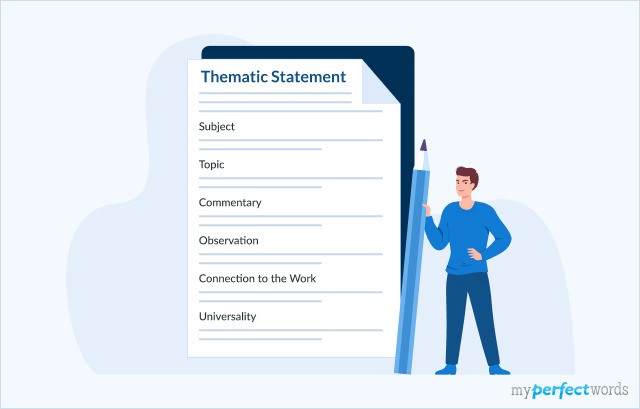
Thematic Statement

Stories often have more to them than meets the eye, and that's where thematic statements come in. 

Simply put, they help unlock the deeper meanings of a story. As a student studying literature, understanding thematic statements is like finding the key to the hidden messages in your favorite books.

In this blog, we’ll explore what thematic statements are and how to write them, with examples. Ready to uncover the magic behind storytelling? 

Let’s dive in!

What is a Thematic Statement?

A thematic statement is a sentence (or two) that expresses the main idea of the writing. It is the central message of a literary work. 

According to the thematic statement definition:

“It is a central message of a literary work that the author wants to convey about the subject.”

Purpose of Thematic Statement

Let’s take a look at what purpose a thematic statement serves: 

  • Conveys the Whole Idea: It encapsulates the essence of a literary work, providing a comprehensive overview of its core idea.
  • Aids Interpretation: These statements assist readers in interpreting the main message of the work, offering insights into the underlying themes.
  • Summarizes Concisely: It aims to deliver a simple and clear interpretation of the topic in one or two sentences.

Order Essay

Paper Due? Why Suffer? That's our Job

Order Now

Parts of a Thematic Statement 

A thematic statement typically consists of three key parts:

  1. Theme: This is the central idea or concept that the statement focuses on. It can be related to love, power, revenge, etc., depending on the literary work. The theme should be expressed in a concise way.
  2. Context: This part ties the theme to the specific literary work or the context within which the theme is explored. It helps to make the statement relevant and focused.
  3. Insight or Message: This is the takeaway or the deeper meaning derived from the theme. It provides an understanding of what the author is trying to communicate about the human experience, society, or life in general.

Example

"The theme of love in Romeo and Juliet reveals how impulsive decisions driven by intense emotions can lead to tragic outcomes."

Theme: Love

Context: Romeo and Juliet

Insight/Message: Impulsive decisions driven by emotions lead to tragedy.

Thematic Statement Template

The following thematic statement template will help you write a good theme statement for your paper.

Template of Thematic Statement

How to Write a Thematic Statement?

While there are no strict rules for writing a thematic statement, following these 7 steps can make the process easier and help create a strong theme statement.

Example Thematic Statement Format:

Here is a thematic statement formula that you can use while crafting one: 

Main Idea + Topic Phrase = Thematic Statement

"The [theme] in [literary work] reveals [insight about human nature/society/experience]."

Step 1. Create a List of Theme Topics

Brainstorm some theme topic ideas and make a list of them. Check which idea can support your argument with evidence from the literature or examples. Choose the one that the literary text can best demonstrate. 

For example,

The list of theme topics for "1984" by George Orwell will include: 

  • Surveillance
  • Government control
  • Individuality vs. conformity
  • The manipulation of truth
  • The impact of oppressive regimes on human relationships

Step 2. Conduct Thorough Research

Research your chosen theme to collect relevant material and see what others have written about it. Read the available literature work thoroughly to analyze what could be the central message of your work. Carefully examine the plots, characters, writing styles, and different human perspectives. It will help you develop an original interpretation.

For example,

  • Research totalitarianism and surveillance in historical and contemporary contexts. 
  • Study Orwell's life and influences. 
  • Examine the novel for instances of government control and surveillance

Step 3. Pick out Thematic Statements of Other Writers

While reading the literature work, pick out the statements of other authors. Analyze what others think about your chosen subject/topic and how they have conveyed their thoughts.

For example,

Author 1: "In George Orwell's 1984, the novel explores the dangers of totalitarianism and the loss of personal freedom under oppressive regimes."

Author 2: "Orwell's 1984 highlights the dehumanizing effects of government surveillance, where individual identity and freedom are sacrificed for the illusion of security."

Step 4. Identify Conflict Areas

Every theme or topic has a conflict of ideas that is necessary to understand the central theme completely. Identifying the conflict area will help you analyze the central concept for your work. It will also guide you to determine the motives and values to understand the nature of the conflict. 

For example,

Explore the conflict between the protagonist Winston Smith and the oppressive government. Analyze the tension between conformity and individual rebellion.

Step 5. Focus on the Crux

The purpose of the statement is to present the complete message of the work in one sentence. Therefore, it is important to focus on the crux or core instead of talking about what or how.

For example,
Craft a statement that captures the core message, such as:

"In a dystopian society dominated by omnipresent surveillance, George Orwell's '1984' warns of the dehumanizing effects of totalitarian control on individual autonomy."

Step 6. Avoid Directive and Moral Edict

A theme statement aims to assess and reflect upon actions and ideas rather than prescribe or dictate how individuals should behave. It is crucial to steer clear of making moral judgments or giving directives. 

So, it is advisable to avoid using words such as ought, should, must, or any similar terms that imply imposition. Instead, focus on presenting observations and considerations without implying a set course of action.

For example,

Avoid statements like,

"Readers should resist oppressive governments." 

Instead, focus on observation, e.g.,

"Orwell highlights the consequences of unchecked government power."

Step 7. Avoid Cliches

Cliches have already been used several times, and they do not sound unique anymore. So, it's better to come up with an original statement for your work.

For example,

Instead of a cliché like "Big Brother is watching," develop a unique perspective: "Orwell's '1984' unveils the chilling reality of a society where every action is scrutinized, revealing the true cost of sacrificing privacy for the illusion of security."

Order Essay

Tough Essay Due? Hire Tough Writers!

Order Now

Thematic Statement Examples

The following thematic statement examples will help you understand what a good statement looks like. 

Thematic Statements for The Hunger Games

"The Hunger Games explores the impact of social inequality and oppression on human survival."

"The story examines how the pursuit of power leads to corruption and violence."

"Sacrifice and loyalty are key themes in the fight against an oppressive regime."

Thematic Statements for Harry Potter

"The series highlights the power of love and friendship in overcoming evil."

"Harry Potter explores the importance of choice in shaping one's destiny."

"The fight between good and evil is central to the battle for justice and equality."

Thematic Statements for The Fault in Our Stars

"The story explores love and loss in the face of terminal illness."

"Personal growth and resilience are key themes in dealing with grief and illness."

"The novel shows how relationships shape our understanding of life and death."

Thematic Statements for Black Panther

"Black Panther explores identity, heritage, and the responsibilities of leadership."

"The movie addresses the power of unity and solidarity in facing societal challenges."

"Cultural heritage and responsibility are key themes in overcoming oppression."

Thematic Statement Examples for Love

“Love can conquer even the greatest evil”

“Love makes you care about others more than yourself”

“Love, if taken to the extreme, can be negative rather than positive”

Thematic Statement Examples for Death

“A man who lives fully is prepared to die anytime”

“Death is so beautiful that whoever meets it never comes back”

“To die will be an awfully amazing adventure”

Thematic Statement Examples of Identity

“Be who you are, and the world will adjust”

“Never forget what you are, for surely the world will not”

“We know what we are, but not what we may be”

Thematic Statement Examples for Fear

“Fear is something more dangerous than the danger itself”

“Fear is nothing more than just a state of mind”

“The biggest thing to fear about is fear itself”

Thematic Statement for Racism

“Racism is an institutionalized form of discrimination that exists in our society today”

“Racism results in the exclusion of certain groups from full participation in society”

“Racism leads to social and economic inequality”

Thematic Statement About Friendship

"Friendship is life's colorful thread, weaving joy and shared memories."

"Like a guiding compass, friendship directs our life's journey with shared experiences."

"In life's symphony, friendship is the harmonizing chord of shared humanity."

Thematic Statement Examples For Identity 

"Authenticity blooms through self-discovery's intricate journey."

"Identity mirrors life's mosaic, shaped by love and resilience."

"Life's twists reveal a unique identity tapestry."

Thematic Statement Examples in Literature

"Love in literature weaves hearts into a tapestry of shared experiences."

"In life's tapestry, literature adds color, meaning, and depth through the thread of love."

"Literature, a symphony of words, harmonizes individual stories into a composition of shared emotions and connections."

Thematic Statement for the Cask of Amontillado

"Revenge, when taken to extremes, can consume a person and lead to their moral downfall."

"Pride and arrogance can cloud judgment, leading to dangerous consequences."

"The desire for vengeance can blind individuals to the consequences of their actions, leading to their own destruction."

Thematic Statement Vs Theme

Let’s explore what is the actual difference between a theme and a thematic statement:

Aspect

Theme

Thematic Statement

Definition

Central idea or message explored in a work of literature or art.

Concise statement expressing the core theme or message of a specific work.

Nature

Broad, abstract concept.

Specific, focused, and interpretative.

Scope

Applies across various works and genres.

Tailored to a particular literary work or piece of art.

Example (for "1984")

Totalitarianism, Surveillance, Individual vs. Society.

"In '1984,' Orwell warns of the dehumanizing effects of totalitarian control on individual autonomy."

Thematic Statement Versus Topic 

The table below summarizes key differences between thematic statements and topics:

Aspect

Thematic Statement

Topic

Definition

Captures the central message or insight of a work.

Describes the general subject or area

Specificity

Concisely conveys the essence in one or two sentences.

Offers a broader focus for exploration.

Example (for "1984")

"Totalitarianism dehumanizes individuals in '1984'."

"Totalitarianism in '1984'."

Focus

Targets the core meaning, avoiding surface details.

Addresses the subject without delving into deeper interpretations.

Thematic Statement Versus Thesis Statement

Understanding the difference between a thematic statement and a thesis statement is important to avoid any confusion. Here’s a comparison to clarify their roles:

Aspect

Thematic Statement

Thesis Statement

Definition

Central message or theme of a work.

Main argument or claim of an essay or research paper.

Purpose

To express the underlying message or theme.

To present the main argument or point of the essay.

Focus

Focuses on universal themes or ideas.

Focuses on a specific argument or analysis in the essay.

Context

Commonly used in literary analysis or art interpretation.

Commonly used in essays, research papers, or arguments.

Example

"Revenge can destroy a person’s humanity."

"In The Cask of Amontillado, Poe explores how revenge leads to self-destruction."

Thematic Statement Versus Thesis Statement

Understanding the difference between a thematic statement and a thesis statement is important to avoid any confusion. Here’s a comparison to clarify their roles:

Aspect

Thematic Statement

Thesis Statement

Definition

Central message or theme of a work.

Main argument or claim of an essay or research paper.

Purpose

To express the underlying message or theme.

To present the main argument or point of the essay.

Focus

Focuses on universal themes or ideas.

Focuses on a specific argument or analysis in the essay.

Context

Commonly used in literary analysis or art interpretation.

Commonly used in essays, research papers, or arguments.

Example

"Revenge can destroy a person’s humanity."

"In The Cask of Amontillado, Poe explores how revenge leads to self-destruction."

Thematic Statement Writing Dos and Don’ts

Here are some do’s and don’ts that will help you create an impactful thematic statement: 

Dos 

  • Be Clear and Concise: Express the central theme with precision and simplicity.
  • Explore Depth: Uncover underlying emotions or ideas to add layers of meaning.
  • Make It Universal: Create a statement that resonates broadly and relates to universal experiences.
  • Maintain Consistency: Use a consistent tone and language throughout the statement.
  • Engage with Examples: Use vivid language or examples to illustrate the theme effectively.

Don’ts

  • Avoid Vagueness: Don’t use ambiguous language; be explicit to prevent confusion.
  • Don’t Overcomplicate: Keep the statement straightforward to preserve its impact.
  • Don’t Lose Focus: Stick to the central theme and avoid introducing unrelated concepts.
  • Don’t Overgeneralize: Be specific; avoid broad and shallow statements.
  • Don’t Ignore Tone: Ensure your tone aligns with the theme to avoid creating a disconnect.

To Wrap it Up!
In this blog, we talked about how to create powerful thematic statements for stories. We covered the important parts and why it's crucial to keep things clear. 

Now, we hope you feel more confident in understanding and expressing the deeper messages in the stories you read. If you get stuck, we are here to 'do my essays' on your behalf.

Whether you need just a thematic statement or a complete paper, we have got it all covered. So contact us today!

Frequently Asked Questions

What is a thematic topic?

A thematic topic is a broad, unifying subject that encompasses related themes or concepts in a particular context, such as literature. It provides a framework for exploring underlying messages or issues. For example, in literature, a thematic topic could be "power," serving as a lens to analyze how power dynamics are portrayed in different works.

How do I identify the central theme of a literary work?

Identify a literary work's central theme by recognizing recurring ideas, motifs, or messages, and noting key symbols or character developments that convey the overarching concept. It's the narrative's underlying message that unifies the story.

How long is a thematic statement?

A thematic statement is typically one to two sentences long. It should be concise while effectively expressing the central theme or message of a literary work.

What is the thematic statement of Romeo and Juliet?

Here are a few examples of thematic statements for Romeo and Juliet:

  • The play explores how love and hate are interconnected, often leading to destructive consequences.
  • In Romeo and Juliet, impulsive decisions driven by intense emotions lead to tragedy and death.
  • The theme of fate plays a crucial role in the tragic downfall of Romeo and Juliet, highlighting the inevitability of their doomed love.
Barbara P

Barbara P Verified

Dr. Barbara is a highly experienced writer and author who holds a Ph.D. degree in public health from an Ivy League school. She has worked in the medical field for many years, conducting extensive research on various health topics. Her writing has been featured in several top-tier publications.

Specializes in:

Literature Marketing
Read All Articles by Barbara P

Keep Reading

13 min read

Learn How to Write an Editorial on Any Topic

How to Write an Editorial
6 min read

Best Tips on How to Avoid Plagiarism

How to Avoid Plagiarism
How to Write 8 min read

How to Write a Movie Review - Guide & Examples

How to Write a Movie Review
General Guides 10 min read

A Complete Guide on How to Write a Summary for Students

How to Write a Summary
Essay Guides 11 min read

Write Opinion Essay Like a Pro: A Detailed Guide

How to Write an Opinion Essay
How to Write 13 min read

Evaluation Essay - Definition, Examples, and Writing Tips

Evaluation Essay
General Guides 10 min read

How to Write a Bio - Quick Tips, Structure & Examples

How to Write a Bio
How to Write 9 min read

How to Write a Synopsis – A Simple Format & Guide

How to Write a Synopsis
Essay Guides 10 min read

How to Write a Comparative Essay – A Complete Guide

Comparative Essay
General Writing 62 min read

How to Write a Visual Analysis Essay: Complete Guide with Examples

Visual Analysis Essay
General Guides 12 min read

List of Common Social Issues Around the World

List of Social Issues
Essay Writing 13 min read

Writing Character Analysis: Outline, Steps, and Examples

Character Analysis
General Guides 10 min read

11 Common Types of Plagiarism Explained Through Examples

Types of Plagiarism
9 min read

Article Review Writing: A Complete Step-by-Step Guide with Examples

Article Review
General Guides 13 min read

A Detailed Guide on How to Write a Poem Step by Step

How to Write a Poem
7 min read

Detailed Guide on Appendix Writing: With Tips and Examples

Appendix Writing

On this Page

Share This Article

Share " How to Write a Thematic Statement with Examples" with others

Share via
Link copied to clipboard!
MPW Logo White
  • Phone Icon (+1) 888 687 4420
  • Email Icon info@myperfectwords.com
facebook Icon instagram Icon twitter Icon pinterest Icon youtube Icon tiktok Icon linkedin Icon google Icon

Company

  • About
  • Samples
  • FAQs
  • Reviews
  • Pricing
  • Referral Program
  • Jobs
  • Contact Us

Legal & Policies

  • Terms
  • Privacy Policy
  • Cookies Policy
  • Refund Policy
  • Academic Integrity

Resources

  • Blog
  • EssayBot
  • AI Detector & Humanizer
  • All Services

We Accept

MasterCard Visa Express Discover

Created and promoted by Skyscrapers LLC © 2026 - All rights reserved

Disclaimer: The materials provided by our experts are meant solely for research and educational purposes, and should not be submitted as completed assignments. MyPerfectWords.com firmly opposes and does not support any form of plagiarism.

dmca Image sitelock Image pci Image secure Image
Cookie

We Use Cookies

We use cookies for essential website functions and to better understand how you use our site, so we can create the best possible experience for you.

Privacy Policy