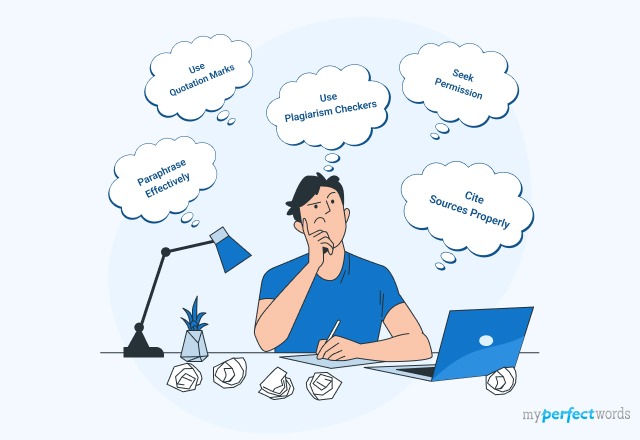
Tips on Avoiding Plagiarism
Whether you are a student or a professional, avoiding plagiarism is crucial to maintaining your integrity.
Let’s take a look at how to avoid plagiarism in your research methodology or assignments as a student:
Cite Sources Properly
Different citation styles have specific rules for citing various sources. Learn the intricacies of the citation style recommended by your institution.
This includes understanding how to cite books, articles, websites, interviews, and other sources within the text and in your bibliography or reference list.
Let’s take a look at the APA citation style book format to help you understand the concept:
APA Citation Format: In-text citation: (Author's Last Name, Year, Page Number) Reference List: Author's Last Name, First Initial. Second Initial. (Year). Title of the Book. Publisher. Example: In-text citation: (Smith, 2020) Reference List: Smith, J. K. (2020). The Art of Writing. ABC Publishers. |
Paraphrase Effectively
Paraphrasing is more than just swapping words; it involves understanding the concept and putting it into your own words completely.
Ensure the meaning remains intact while the wording is entirely your own.
Let’s take a look at an example for a better understanding;
Original text: "The Industrial Revolution brought about significant changes in society and marked a shift from agrarian to industrial economies." Paraphrased: "The transformation of society during the Industrial Revolution signified a move away from agricultural-based economies toward industrial ones." |
Use Quotation Marks
When directly quoting, enclose the quoted text in quotation marks. Provide a citation indicating the author, publication year, and page number.
This practice not only credits the original author but also distinguishes their words from your own.
Look at the example below:
Direct Quote with Parenthetical Citation: As Shakespeare wrote, "To be, or not to be, that is the question" (Year, Act Scene Line). |
Use Plagiarism Checkers
These tools can help identify potential instances of unintentional plagiarism by comparing your work against a vast database of existing content.
However, remember that these tools aren't foolproof and should be used as aids while still reviewing and correcting any issues yourself.
Seek Permission
If you plan on using copyrighted material or someone's proprietary work, seek explicit permission before integrating it into your own work.
This includes images, text excerpts, or any content that's protected by copyright laws.
Different Types of Plagiarism and How To Avoid Them
There are different types of plagiarism, extending beyond direct copying.
Here are some of the most common plagiarism types:
Complete Plagiarism
This is the most overt form of plagiarism. It involves entirely copying someone else's work and presenting it as your own without any acknowledgment of the original source.
How to Avoid:
- Always attribute the original source when using someone else's work.
- Paraphrase and summarize information instead of directly copying entire passages.
- Use quotation marks for verbatim text and provide proper citations.
Verbatim Plagiarism
Verbatim plagiarism occurs when someone directly copies text word-for-word from a source without giving proper attribution.
It's essentially replicating someone else's exact words without quotation marks or citations.
How to Avoid:
- When directly quoting, use quotation marks and provide a citation.
- Paraphrase the original text in your own words while still crediting the source.
Mosaic Plagiarism
Mosaic plagiarism involves taking pieces of content from different sources and integrating them into your work without proper citation.
It's like creating a patchwork of ideas from various sources without acknowledging where they originated.
How to Avoid:
- Clearly attribute each idea or piece of information to its original source.
- Use proper citation styles to credit individual sources used within your work.
Self-Plagiarism
Self-plagiarism occurs when an individual reuses their own previously published work without indicating that it's not new or failing to cite its previous use.
Even if it's your own work, not acknowledging its prior publication is considered unethical.
How to Avoid:
- If reusing your own work, acknowledge its prior use and indicate where and when it was previously published.
- Seek permission from the publisher if you plan to repurpose your previously published work.
Accidental Plagiarism
Accidental plagiarism happens when someone unintentionally fails to give proper credit to the original source.
It can occur by forgetting to cite sources, inadequately paraphrasing, or not correctly attributing ideas.
How to Avoid:
- Take thorough notes and clearly mark which parts are direct quotes.
- Always cite the source of any information or idea that is not common knowledge.
- Use plagiarism detectors to ensure proper citation and avoid similarities with the source material.
Inaccurate Citation
Inaccurate citation refers to improperly citing sources or misrepresenting the origin of information.
This can include incorrect formatting, misquoting, or misplacing citations, which might mislead readers into thinking the information is original to the writer.
How to Avoid:
- Familiarize yourself with the appropriate citation style for your field (APA, MLA, etc.).
- Check citation guidelines regularly and ensure accuracy in formatting and placement of citations within your work.
- Cross-reference your citations with the original sources to ensure correctness.
So there you have it!
Avoiding plagiarism isn’t just about meeting academic standards; it is an ethical writing practice and the responsibility to credit original authors.
These tips are not just for students but can be used to learn how to avoid plagiarism in content writing.
To add another layer of insurance, trust us to 'do my essay cheap' and fast.
Our professionals will ensure that your work does not contain any kind of plagiarism. Place your order now and get a well-written custom paper according to your requirements.




-10652.jpg)