What is a Comparative Essay?
A comparative essay is a type of essay in which an essay writer compares at least two or more items. The author compares two subjects with the same relation in terms of similarities and differences depending on the assignment.
The main purpose of the comparative essay is to:
- Highlight the similarities and differences in a systematic manner.
- Provide great clarity of the subject to the readers.
- Analyze two things and describe their advantages and drawbacks.
A comparative essay is also known as compare and contrast essay or a comparison essay. It analyzes two subjects by either comparing them, contrasting them, or both. The Venn diagram is the best tool for writing a paper about the comparison between two subjects.
Moreover, a comparative analysis essay discusses the similarities and differences of themes, items, events, views, places, concepts, etc. For example, you can compare two different novels (e.g., The Adventures of Huckleberry Finn and The Red Badge of Courage).
However, a comparative essay is not limited to specific topics. It covers almost every topic or subject with some relation.
Comparative Essay Structure
A good comparative essay is based on how well you structure your essay. It helps the reader to understand your essay better.
The structure is more important than what you write. This is because it is necessary to organize your essay so that the reader can easily go through the comparisons made in an essay.
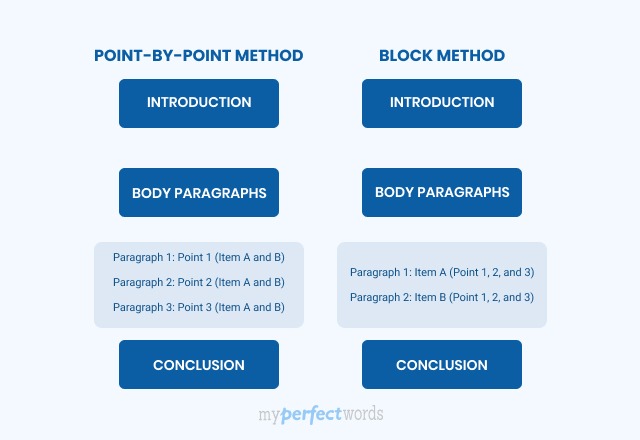
The following are the two main methods in which you can organize your comparative essay.
Point-by-Point Method
The point-by-point or alternating method provides a detailed overview of the items that you are comparing. In this method, organize items in terms of similarities and differences.
This method makes the writing phase easy for the writer to handle two completely different essay subjects. It is highly recommended where some depth and detail are required.
Below given is the structure of the point-by-point method.
Introduction Body Paragraphs
Conclusion |
Block Method
The block method is the easiest as compared to the point-by-point method. In this method, you divide the information in terms of parameters. It means that the first paragraph compares the first subject and all their items, then the second one compares the second, and so on.
However, make sure that you write the subject in the same order. This method is best for lengthy essays and complicated subjects.
Here is the structure of the block method.
Introduction Body Paragraphs
Conclusion |
Therefore, keep these methods in mind and choose the one according to the chosen subject.
Mixed Paragraphs Method
In this method, one paragraph explains one aspect of the subject. As a writer, you will handle one point at a time and one by one. This method is quite beneficial as it allows you to give equal weightage to each subject and help the readers identify the point of comparison easily.
How to Start a Comparative Essay?
Here, we have gathered some steps that you should follow to start a well-written comparative essay.
Choose a Topic
The foremost step in writing a comparative essay is to choose a suitable topic.
Choose a topic or theme that is interesting to write about and appeals to the reader.
An interesting essay topic motivates the reader to know about the subject. Also, try to avoid complicated topics for your comparative essay.
Develop a List of Similarities and Differences
Create a list of similarities and differences between two subjects that you want to include in the essay. Moreover, this list helps you decide the basis of your comparison by constructing your initial plan.
Evaluate the list and establish your argument and thesis statement.
Establish the Basis for Comparison
The basis for comparison is the ground for you to compare the subjects. In most cases, it is assigned to you, so check your assignment or prompt.
Furthermore, the main goal of the comparison essay is to inform the reader of something interesting. It means that your subject must be unique to make your argument interesting.
Do the Research
In this step, you have to gather information for your subject. If your comparative essay is about social issues, historical events, or science-related topics, you must do in-depth research.
However, make sure that you gather data from credible sources and cite them properly in the essay.
Create an Outline
An essay outline serves as a roadmap for your essay, organizing key elements into a structured format.
With your topic, list of comparisons, basis for comparison, and research in hand, the next step is to create a comprehensive outline.
Here is a standard comparative essay outline:
I. Introduction A. Hook Statement B. Background Information C. Thesis Statement II. Body Paragraphs A. Point 1 (Similarity/Difference)
Subject B
Analysis
B. Point 2 (Similarity/Difference)
Subject B
Analysis
C. Point 3 (Similarity/Difference) - (Include additional points as needed) III. Conclusion A. Restate Thesis B. Summary of Main Points C. Significance D. Concluding Statement |
How to Write a Comparative Essay?
Now that you have the basic information organized in an outline, you can get started on the writing process.
Here are the essential parts of a comparative essay:
Comparative Essay Introduction
Start off by grabbing your reader's attention in the introduction. Use something catchy, like a quote, question, or interesting fact about your subjects.
Then, give a quick background so your reader knows what's going on.
The most important part is your thesis statement, where you state the main argument, the basis for comparison, and why the comparison is significant.
This is what a typical thesis statement for a comparative essay looks like:
| In [Subject A] and [Subject B], the [basis for comparison] is evident through [points of similarity/difference]. While [Subject A] [specific point], [Subject B] [specific point], demonstrating [main argument]. This comparison is significant because it [implication ork significance]. |
Comparative Essay Body Paragraphs
The body paragraphs are where you really get into the details of your subjects. Each paragraph should focus on one thing you're comparing.
Start by talking about the first point of comparison. Then, go on to the next points. Make sure to talk about two to three differences to give a good picture.
After that, switch gears and talk about the things they have in common. Just like you discussed three differences, try to cover three similarities.
This way, your essay stays balanced and fair. This approach helps your reader understand both the ways your subjects are different and the ways they are similar. Keep it simple and clear for a strong essay.
Comparative Essay Conclusion
In your conclusion, bring together the key insights from your analysis to create a strong and impactful closing.
Consider the broader context or implications of the subjects' differences and similarities. What do these insights reveal about the broader themes or ideas you're exploring?
Discuss the broader implications of these findings and restate your thesis. Avoid introducing new information and end with a thought-provoking statement that leaves a lasting impression.
Below is the detailed comparative essay template format for you to understand better.
Comparative Essay Examples
Have a look at these comparative essay examples pdf to get an idea of the perfect essay.
Comparative Essay Topics
Comparative essay topics are not very difficult or complex. Check this list of essay topics and pick the one that you want to write about.
- How do education and employment compare?
- Living in a big city or staying in a village.
- The school principal or college dean.
- New Year vs. Christmas celebration.
- Dried Fruit vs. Fresh. Which is better?
- Similarities between philosophy and religion.
- British colonization and Spanish colonization.
- Nuclear power for peace or war?
- Bacteria or viruses.
- Fast food vs. homemade food.
Tips for Writing A Good Comparative Essay
Writing a compelling comparative essay requires thoughtful consideration and strategic planning. Here are some valuable tips to enhance the quality of your comparative essay:
- Clearly define what you're comparing, like themes or characters.
- Plan your essay structure using methods like point-by-point or block paragraphs.
- Craft an introduction that introduces subjects and states your purpose.
- Ensure an equal discussion of both similarities and differences.
- Use linking words for seamless transitions between paragraphs.
- Gather credible information for depth and authenticity.
- Use clear and simple language, avoiding unnecessary jargon.
- Dedicate each paragraph to a specific point of comparison.
- Summarize key points, restate the thesis, and emphasize significance.
- Thoroughly check for clarity, coherence, and correct any errors.
Transition Words For Comparative Essays
Transition words are crucial for guiding your reader through the comparative analysis. They help establish connections between ideas and ensure a smooth flow in your essay.
Here are some transition words and phrases to improve the flow of your comparative essay:
Transition Words for Similarities
- Correspondingly
- Likewise
- Similarly
- In the same vein
- Equally
- Conjointly
- Notably
- In like manner
- In a similar fashion
- In tandem with
Transition Words for Differences
- On the contrary
- In contrast
- Conversely
- Unlike
- Nevertheless
- In spite of
- However
- Notwithstanding
- On the flip side
- In contradistinction
Check out this blog listing more transition words that you can use to enhance your essay’s coherence!
In conclusion, now that you have the important steps and helpful tips to write a good comparative essay, you can start working on your own essay.
However, if you find it tough to begin, all you have to do is say 'just do my essay' and we'll get started.
Our skilled writers can handle any type of essay or assignment you need. So, don't wait—place your order now and make your academic journey easier!






-10652.jpg)