


 (1))
Qualitative vs. Quantitative Research: An Introduction
Qualitative research is a method of inquiry that focuses on understanding human experiences, perspectives, and behaviors through non-numerical data. Instead of counting and measuring, it asks "why" and "how." You're not looking for averages, you're looking for meaning.
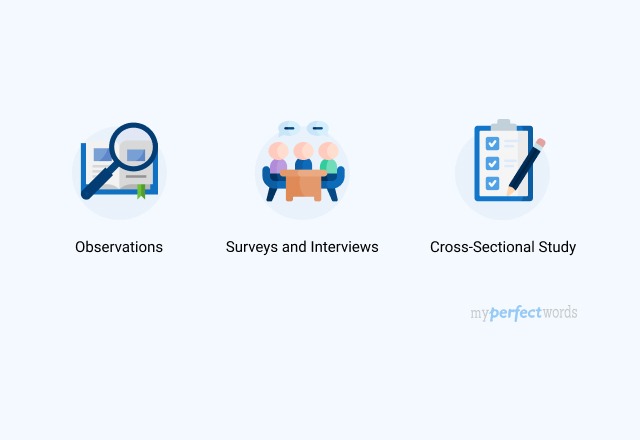
A qualitative study might involve in-depth interviews, focus groups, ethnographic observation, or open-ended surveys. The data comes out as text, descriptions, or visual material, and you analyze it by identifying themes, patterns, and narratives.
Key Characteristics of Qualitative Research
- An exploratory focus that works best when investigating something complex, personal, or not yet well understood.
- You work with small, purposive samples, participants chosen deliberately because of their relevant experience, not randomly for statistical representation.
- The design stays flexible and can evolve as you learn more.
- Findings are context-rich, specific to the people and settings studied rather than generalized across large populations.
| Different approaches exist within qualitative research methods, ethnography, case studies, phenomenology, and more. |
Quantitative research is a method of inquiry that focuses on measuring variables and testing relationships through numerical data and statistical analysis. The goal is to quantify something, to find out how much, how often, or to what extent.
A quantitative study might use structured surveys, experiments, or existing datasets. The data comes out as numbers, and you analyze it using statistical techniques to find patterns, correlations, or differences.
Key Characteristics of Quantitative Research
- An objective, structured design that's fixed before data collection begins, with variables defined upfront
- You need large, randomized samples to make statistically valid claims about a broader population
- The findings are replicable; another researcher following the same method should get similar results.
- Conclusions are generalizable beyond the specific sample studied.
| For a closer look at how quantitative methods work in practice, see the full quantitative research guide. |
Qualitative vs. Quantitative Research: Key Differences
The most important thing to understand is that qualitative and quantitative research aren't just different tools; they answer fundamentally different kinds of questions. One explores; the other measures.
Feature | Qualitative | Quantitative |
Data type | Words, images, observations | Numbers, statistics, measurements |
Goal | Understand "why" and "how" | Measure "what" and "how much" |
Sample size | Small, purposive | Large, randomized |
Methods | Interviews, focus groups, observation | Surveys, experiments, statistical analysis |
Analysis | Thematic, content, discourse analysis | Statistical tests, data visualization |
Flexibility | Flexible, can evolve during the study | Structured, fixed design |
Generalizability | Context-specific findings | Generalizable to larger populations |
Research questions | "How do students experience...?" | "What percentage of students...?" |
The short version: qualitative gives you depth and context; quantitative gives you breadth and measurability. Neither is better. They serve different research purposes, and the right choice comes down entirely to what your study needs to find out.
Qualitative vs. Quantitative Research Questions
The most reliable shortcut for choosing your method is looking at how your research question is worded. The language of a question almost always signals the right approach.
Qualitative Question | Quantitative Question |
How do first-year nursing students experience clinical anxiety? | What percentage of first-year nursing students report high anxiety during clinical placements? |
Why do students choose to use academic writing services? | How many hours per week do students spend on academic writing? |
What does academic pressure feel like for graduate students? | Is there a significant relationship between GPA and reported stress levels? |
How do sociology students construct identity through social media? | How frequently do sociology students use social media for academic purposes? |
If your question starts with "why" or "how," you're almost always looking at qualitative. If it starts with "how many," "how much," "what percentage," or "is there a relationship between," that's quantitative territory.
| For more guidance on forming a strong research question, the how to write a research question article walks through the process step by step. |
Qualitative vs. Quantitative Research Methods
The methods you use depend directly on which approach you're taking.
Common Qualitative Methods
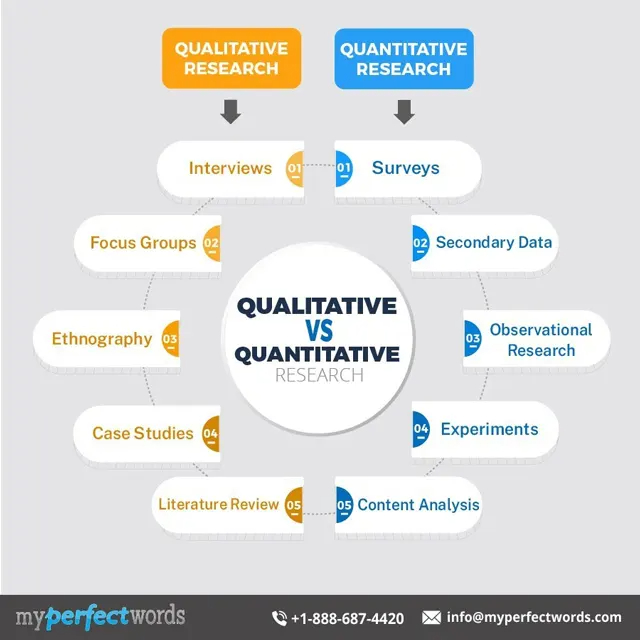
These include in-depth interviews for exploring experiences one-on-one or in groups, focus groups for facilitated discussions on a specific topic, ethnographic observation for immersive in-context study of behavior, document and content analysis for identifying themes in texts or media, and case studies for deep exploration of a specific situation or individual.
Common Quantitative Methods
These include structured surveys with standardized closed or scaled responses, experiments in controlled settings to test cause-and-effect relationships, statistical analysis of existing datasets to find patterns or test hypotheses, and longitudinal studies tracking the same variables across time.
One thing worth noting: surveys can go either way. A survey with open-ended questions that you analyze thematically is qualitative. A survey with Likert scales and numerical responses that you run statistics on is quantitative. The method alone doesn't define the approach; the type of data and how you analyze it do.
| If your paper involves a review of existing studies on your topic, see the guide on how to write a literature review, which covers both qualitative and quantitative sources. |
When to Use Qualitative vs. Quantitative Research
Choosing between them comes down to what your research question actually needs. There's no universal right answer.
Use Qualitative Research When:
You're exploring a topic that hasn't been well studied yet. You want to understand experiences, feelings, or motivations from the inside. Your research question asks "why" or "how." The context matters as much as the outcome.
You're working with a small, specific group where depth matters more than breadth. You want to generate new theories or frameworks rather than test existing ones.
Use Quantitative Research When:
You want to measure the size, frequency, or strength of a phenomenon. You're testing a hypothesis or comparing groups statistically. You need findings that can be generalized to a larger population.
Your research question asks "how many," "how much," or "what is the relationship between." Replicability and objectivity are important for your field. You're building on established theory and want to test whether it holds up.
A student-friendly decision tip: If your research question starts with "how" or "why," go qualitative. If it starts with "how many," "how much," or "what percentage," go quantitative. It's not a perfect rule, but it gets you to the right answer most of the time.
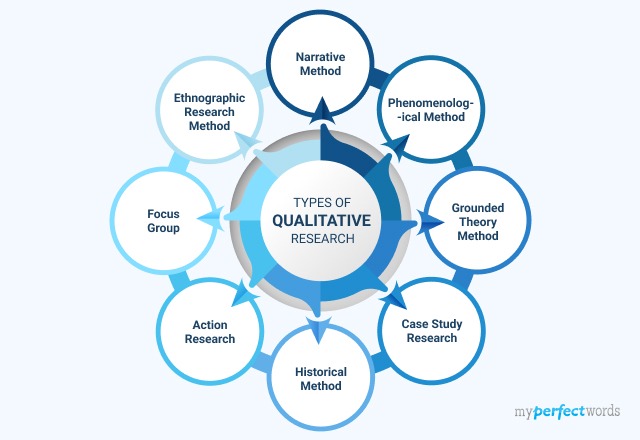
| If you want a deeper look at those, check out the guide to types of qualitative research. |
Qualitative vs. Quantitative Research Examples
Seeing both approaches applied to the same topic is the fastest way to understand the difference.
Topic: Student mental health Qualitative approach: Interview 15 undergraduate students about how academic stress affects their daily routines and coping strategies. Analyze transcripts for recurring themes. Quantitative approach: Survey 300 students using a validated anxiety scale. Calculate mean scores, compare by year of study, and run a regression to identify predictors. Topic: Online learning Qualitative approach: Conduct focus groups with 20 students who switched to remote learning. Explore what felt different about the experience and why. Quantitative approach: Analyze exam scores and attendance data from 500 students across in-person and online cohorts. Test whether format significantly affects academic performance. Topic: Nursing: clinical practice Qualitative approach: Interview ICU nurses about how they cope emotionally with patient loss. Identify themes around support systems, rituals, and institutional factors. Quantitative approach: Survey 200 nurses across 10 hospitals using a burnout inventory. Measure the correlation between nurse-to-patient ratios and reported burnout scores. Topic: Sociology: identity and social media Qualitative approach: Conduct ethnographic observation of a university student group's social media activity over six weeks. Analyze how members construct and present identity online. Quantitative approach: Survey 400 sociology students on their social media habits, measuring frequency, platform use, and self-reported identity consistency across platforms. |
The pattern holds across every topic: qualitative goes deep into individual experience; quantitative measures and compares across populations.
Need Your Research Paper Written by an Expert?
Our writers handle qualitative and quantitative research papers across all subjects.
Expert guidance can make work clearer and more manageable.
Advantages and Disadvantages of Qualitative and Quantitative Research
Qualitative | Quantitative | |
Main strengths | Rich, contextual insights; explores complexity; flexible design; captures nuance | Measurable, replicable, generalizable; statistical rigor; efficient at scale |
Main limitations | Hard to generalize; time-intensive; researcher bias possible; small samples | Misses context and meaning; requires large samples; may oversimplify complex issues |
Best for | Exploratory research, lived experience, emerging topics | Testing hypotheses, measuring relationships, large-population studies |
Qualitative research gives you depth at the cost of breadth. Quantitative research gives you breadth at the cost of depth. The right trade-off depends entirely on what your study is trying to find out.
How to Analyze Qualitative vs. Quantitative Data
Analysis looks completely different depending on your approach, and understanding this upfront helps you plan your study more effectively.
Qualitative Data Analysis
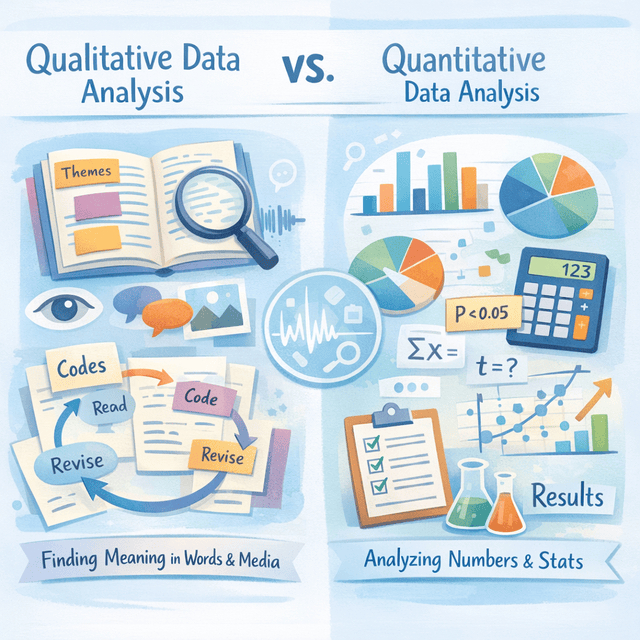
This involves working with text, audio, or visual material to find patterns and meaning. Thematic analysis identifies recurring themes across interviews or responses. Content analysis systematically categorizes and codes text. Discourse analysis examines how language constructs meaning in context.
The process is iterative; you read, code, revise, and re-read until the themes are stable. Researcher interpretation plays a major role, which is why reflexivity matters in qualitative work.
Quantitative Data Analysis
This involves running statistical procedures on numerical data. Descriptive statistics summarize your data with means, medians, frequencies, and standard deviations. Inferential statistics that include t-tests, ANOVA, chi-square tests, help you make claims about broader populations from your sample.
Correlation and regression tests examine relationships between variables. Note that correlation measures association, not causation. The process is more linear: collect, clean, analyze, report.
"If your study uses both approaches, you'll need both types of analysis. Mixed methods studies often run them in parallel and then bring the findings together at the interpretation stage."
Mixed Methods Research: When You Need Both
Sometimes one approach isn't enough. Mixed methods research combines qualitative and quantitative methods in a single study to get a more complete picture.
It makes sense when numbers alone can't explain the "why," or when you want to validate qualitative findings at a larger scale.
| For example, a researcher might survey 500 students and find that 62% report significant study anxiety (quantitative), then conduct 20 in-depth interviews to understand what that anxiety actually feels like and what's causing it (qualitative). The numbers tell you the scope of the problem; the interviews tell you what's driving it. |
Mixed methods studies require more time and resources, but they're increasingly common in fields like education, nursing, psychology, and social science, anywhere human experience intersects with measurable outcomes.
| If your research design involves both types of data, the research design article covers the frameworks in more detail. |
Conclusion
Choosing between qualitative and quantitative research isn’t a one-size-fits-all decision. It depends on your specific research question and what you’re trying to understand.
As we wrap up this comparison, it’s important to remember that both methods have strengths. In some cases, researchers even combine them using a mixed-methods approach.
By understanding their advantages, limitations, and when to use each one, you can choose the right method and conduct your research more effectively.
Let Our Experts Handle Your Research Paper
Whether it's qualitative, quantitative, or mixed methods, we've got you covered.
- Matched with a specialist writer for your methodology and subject
- Original, plagiarism-free work with AI detection proof included
- Deadlines from 3 hours to 14 day, you choose
- Satisfaction guaranteed with free revisions on every order
Save time and learn more with expert research support.
Place Order Now
-20615.png)

-20655.png)
-20737.png)
-9374.jpg)


-20592.png)
-20591.png)

-20668.png)
-20612.png)
-20657.png)


-20577.png)
-20575.png)


-20578.png)



 (2))
)
 (1))
 (1))
 (1))
 (1))
 (1))
 (1))
-20419.png)
-20426.png)
-20431.png)
-20738.png)
-20739.png)
-20745.png)
-20755.png)